Materials and the Hand
What Prototyping Reveals in Shooting Accessories
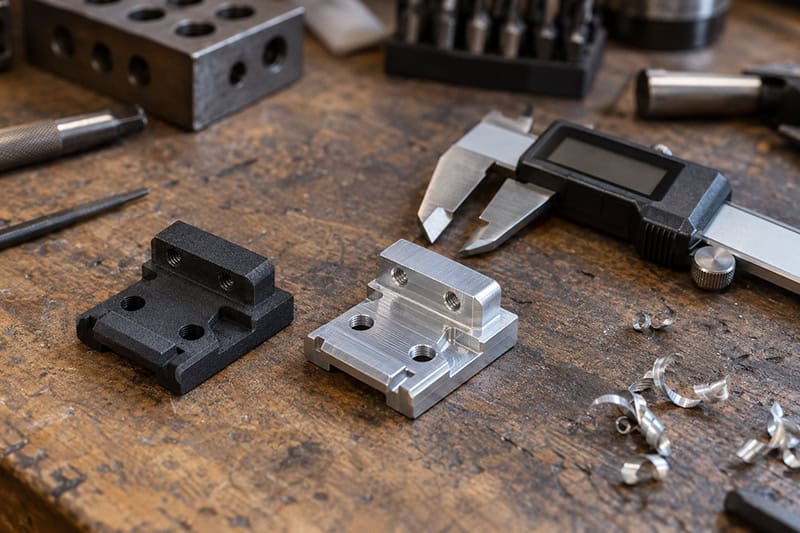
A printed nylon prototype beside a machined aluminum version of the same mount:
one for fit checks, one for function testing.
Sights, optic mounts, holsters, grips, magazines and range gear get judged in seconds and trusted for years. When one fails, the cause is usually the material or the way it handles. The LA New Product Development Team (LA NPDT) in Ruston, Louisiana, designs, engineers and prototypes products in-house, testing both material and handling while prototyping.
For dealers, the lesson is simple: the accessories that keep selling are the ones built on sound engineering, not marketing claims. Materials, finishes, testing methods and platform fit all determine whether a product earns customer trust or comes back across the counter as a return.
When evaluating new sights, holsters, mounts, magazines or range gear, ask the questions that matter: What is it made from? How was it finished and tested? Was it validated on production parts or prototypes? Which firearm models was it actually fit-checked on? Manufacturers with solid answers are usually the manufacturers whose products stay in customers’ hands.
Materials: Match the Material to the Job
Glass-filled nylon (PA6 or PA66-GF) is the workhorse for polymer frames, magazines and mounts. It is stiff and resists heat and solvents, but absorbs moisture, which slightly shifts dimensions and stiffness. Holsters are usually thermoformed Kydex or Boltaron. Boltaron is rated tougher and more resistant to cold cracking, and both can soften in a hot vehicle.
For steel, 4140 is the tough, machinable standard, and 4150 adds carbon for wear resistance, which is why it is common in AR barrels. Both need a protective finish. 17-4 stainless resists corrosion and hardens with little distortion, but costs more and can gall. 7075-T6 aluminum is much stronger than 6061-T6, which costs less and resists corrosion better. Tritium sights glow in the dark but dim over the years, while fiber optic is bright in daylight but needs ambient light.
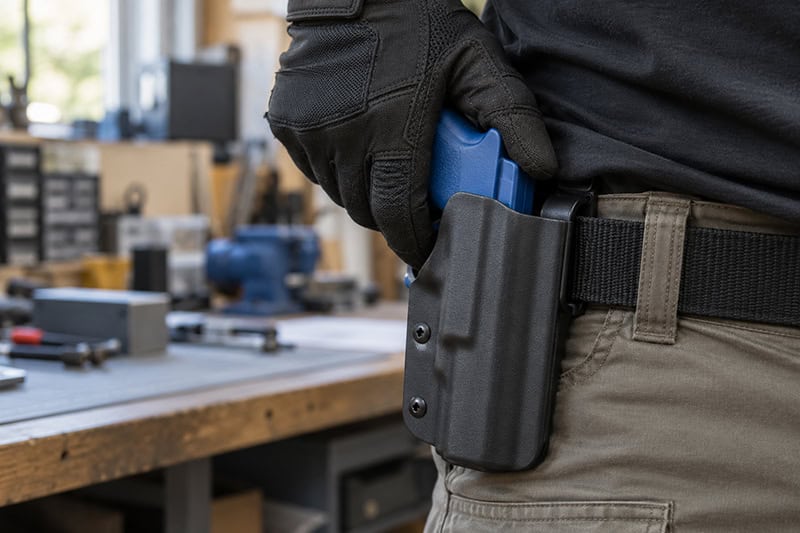
Checking draw, reholstering and retention with gloves on.
Coatings Change Fit, Not Just Looks
Cerakote, a thin ceramic-polymer finish, adds thickness, so mating surfaces need masking. Salt-bath nitride (Melonite or QPQ) is a diffusion hardening treatment for steel, not an applied coating. It reaches bores and barely changes dimensions, so parts are machined to final size first. Type III hard-coat anodizing gives aluminum a hard, wear-resistant surface, and part of the layer grows outward. DLC is very hard, slick and thin, but costly. Phosphate (Parkerizing) holds oil but relies on that oil to resist rust.
Prototype in the Right Material
Printed nylon suits quick fit checks across several guns. CNC-machined aluminum is better for function testing under recoil. Printed parts are built in layers, can be weaker between layers and don’t have the fiber alignment of molded glass-filled nylon, so a printed part can pass a test the molded part fails, or the reverse. Final checks belong on production-intent parts with the real coating.
User Experience: How It Feels and Operates
A product should feel right in the hand, with grip texture, edges and balance that suit the shooter. It has to work with gloves on and with wet or cold hands. A holster should give a clean, consistent draw and accept the gun back without fumbling. Slides, sight cuts, rails and frames vary between models and generations, so check fit on every platform the package claims. Controls should be fast and obvious, so a new owner can operate the product correctly without reading the instructions.
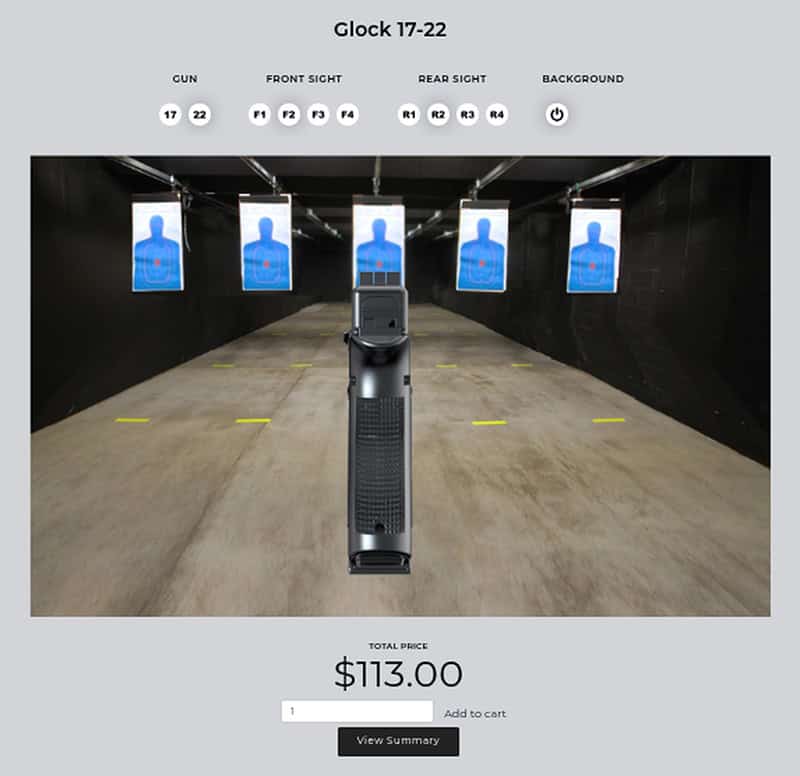
Big Sight Systems' online configurator for the Glock 17 and 22. Image: bigsightsystems.com
Helping Customers Choose
LA NPDT built online configurators for Big Sight Systems that provide oversized Glock sights for shooters with declining near vision. A shooter picked a pistol, compared four front and four rear sizes as a rendered sight picture at arm’s length, and was offered only sizes the company made. Since then, many shooters with declining near vision have moved to pistol red dots, which solve the same problem a different way. User needs keep shifting, so research what your customers need today, not what they used when they first started shooting.
Offer Accessories That Stay Sold
In today’s crowded accessory market, success comes from more than innovative features. It comes from disciplined material selection, realistic testing and a user experience that works under real-world conditions.
Whether it’s a sight set, optic mount, magazine or holster, dealers should look beyond specifications and focus on how the product was engineered, validated and matched to the end user. The manufacturers that do this consistently build trust, and trust is still the most valuable currency in the firearms industry.
Bottom line: when the right materials meet thoughtful design and proven usability, accessories don’t just sell, they stay sold.
About the author: Konstantin Dolgan, Ph.D., is CEO of LA New Product Development Team (LA NPDT) in Ruston, Louisiana, a product development firm that designs, engineers and prototypes products in-house, from idea to proven functional prototype, and builds the software that supports them. Contact: hello@lanpdt.com, 318-200-0526. More information: lanpdt.com
Get The Dealer Advantage Every Week!
By submitting this form, you are consenting to receive marketing emails from: . You can revoke your consent to receive emails at any time by using the SafeUnsubscribe® link, found at the bottom of every email. Emails are serviced by Constant Contact