When Sales Slow: How Firearms Retailers Can Avoid the Merchant Cash Advance Trap
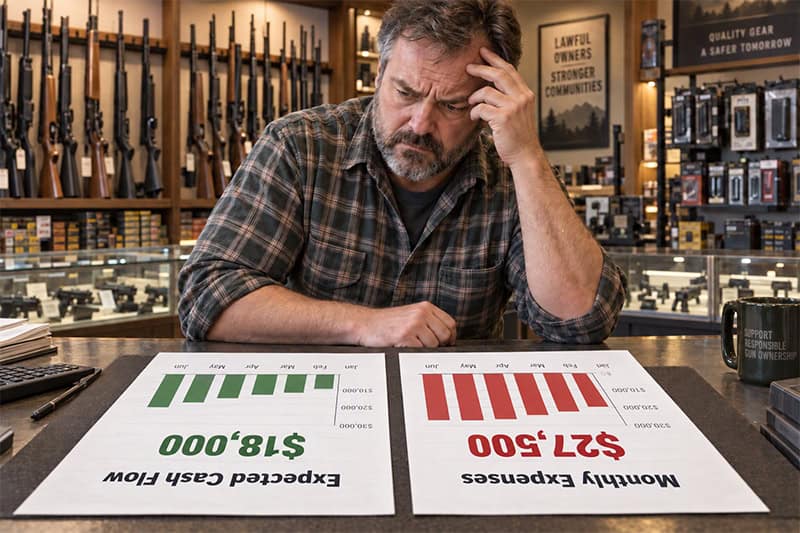
Anyone who owns a gun shop knows that income varies from month to month, depending on many factors. It could be the season. It could be new legislation that makes ownership easier or harder. There can be a boom month, followed by one where the guns just sit on the rack gathering dust. Those slow stretches can strain the bank account, especially because there are fixed costs to cover.
Why gun shop cash flow is so uneven
Demand in this industry is tied to many things outside an owner’s direct control. News events and elections can drive far more customers through the door at some times than at others. Hunting season brings a wave of rifles and ammunition sales, and the holiday rush adds more. But the months after, and the stretches in between, can be a lot slower.
There is also a lot of money tied up in inventory. Firearms and ammunition are expensive to stock, and the shop has to pay for that inventory before it sells.
Then there are the steady costs: rent, payroll, compliance, recordkeeping, security, marketing and more. All of them need to be paid whether the guns are moving or not.
Why fast money can look like a good idea
It’s very common for gun shop owners to get emails promising $200,000 available right away at some attractive-sounding rate. It looks like a quick and easy way to solve a cash problem.
That’s why it’s important to understand how a merchant cash advance is structured. Instead of an annual percentage rate, it uses what’s called a factor rate, typically between 1.3 and 1.5. If a shop takes $100,000 at a factor rate of 1.5, it pays back $150,000, usually over 6 to 10 months. That is an expensive way to borrow.
The payments typically come out as daily or weekly withdrawals, and those debits come out whether or not income is coming in. Often they can take much of a business’s profit.
What happens next is common. Several months later, the owner realizes the business isn’t bringing in enough to pay off the first advance, so they take a second one, which tides them over for a while, and then a third, until it becomes clear it isn’t a viable solution. You can’t dig your way out of a pit.

Questions to ask before you sign
What is the total amount I will pay back, including all fees?
How much will come out daily or weekly, and how does that compare to my worst months?
Over how many months will it be repaid?
Is there a personal guarantee, a confession of judgment, or a UCC lien being filed?
If my business income goes down, what will the payment be adjusted to, and how low can it go?
Know the risks
Most of these advances, and nearly all of the ones I’ve seen over the last 25 years, are personally guaranteed, include a confession of judgment and allow the funder to file a UCC lien. That means if the business can’t pay, the funder can go after the owner’s personal assets, and it could affect the owner’s personal credit as well. Before signing, it’s important to ask honestly: is that a risk I’m willing to take on?
When a merchant cash advance may make sense
There are times when one can be a good tool. If you know with reasonable certainty that the advance will generate a return, for example because you consistently have a wave of orders coming in the next 30 days and need to stock up to take advantage of it, then fast money you’re confident you can pay back can be a great investment.
In other cases, it can make things worse. If it’s hard to make payroll or the business isn’t doing as well as you want, using a merchant cash advance just to push the deadline out a couple of months can deepen the problem instead of solving it.
Plan for your worst month
Before taking any advance, look at your last 12 months of income and the month-to-month swings. Then look at your worst month and ask yourself: could you cover everything, including the advance payments and all your other obligations, in that month?
When you do take one, try to negotiate terms so the payments are no more than 50% of the cash available in your worst months. That buffer helps you anticipate and prevent problems down the road.
Warning signs that you may need help
You’re using one merchant cash advance to pay another.
You have very little left in your bank account after the daily or weekly debits.
You’re behind on payroll taxes, or paying them late.
You’re delaying payments to distributors or asking them for longer terms.
If any of these are true, start by reaching out to your funders to see whether the payments can be worked out. Most agreements include a clause that allows the payments to be adjusted if your income drops, and uploading your agreements to an AI tool such as ChatGPT or Claude can help you find it quickly. Have an attorney confirm what it means for you.
If that doesn’t solve things, it may be time to work with a business debt resolution specialist who can help with restructuring or another alternative. That way you can focus on your gun shop and make it the one you dreamed it would be, and let someone else handle the advances.
About the author: Eric Pemper is the founder of CuraDebt, in business since 2001, and has 25 years of experience in the debt relief industry. Learn more at curadebt.com.
Get The Dealer Advantage Every Week!
By submitting this form, you are consenting to receive marketing emails from: . You can revoke your consent to receive emails at any time by using the SafeUnsubscribe® link, found at the bottom of every email. Emails are serviced by Constant Contact