Building Tomorrow’s Shooters Today
What Retailers Can Learn From One Girl’s Journey
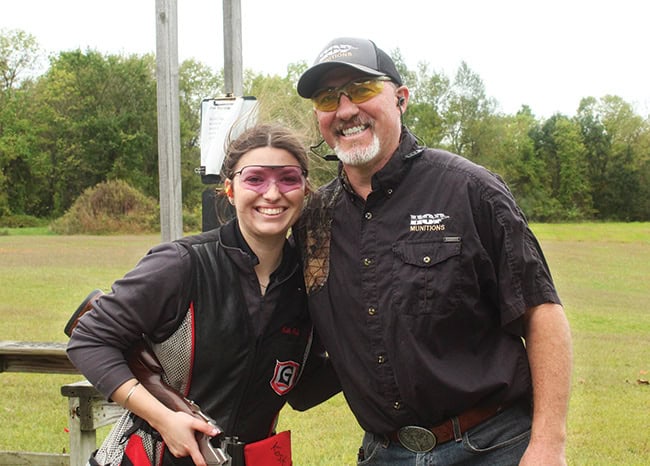
Ruth Abel Boyer and her father, Mark Abel, attend a shooting match fundraiser
for their alma mater, Grace College, in Winona Lake, Ind.
When Ruth Abel Boyer first started shooting with her dad, Mark Abel, neither of them imagined it would ignite a passion that would shape not only her future but also the future of other young people. Her journey is more than just a personal success story; it shows how teaching kids to shoot can create wonderful memories, strong communities and lifelong relationships — and also create an investment in the future of the industry.
All It Takes Is One
Boyer attended a small private Christian high school. Her graduating class only had around a dozen students.
“We were so small we didn’t have any sports,” laughs Boyer. Then a friend of her dad’s wondered if kids would be interested in trap shooting if he would step up to coach. Of course, the kids were interested, and so it began. He got the team set up and registered them in the Scholastic Clay Target Program (SCTP) and the Amateur Trapshooting Association (ATA). Boyer and her brother were two of the competitors.
“He was such an awesome guy for doing that for us,” Boyer beams.
Fast-forward to college. The SCTP sponsors a college fair where any college with a shooting sports program can attend and set up an informational booth. At these events, students can meet coaches and recruiters and see what schools offer. “Because it’s kind of a lesser-known sport and program, a lot of schools don’t advertise it as much, and kids have a harder time finding somewhere to go if they want to continue shooting in college,” Boyer explains. “It’s a really great opportunity for the kids to meet colleges and recruiters and go to schools they didn’t realize had that kind of program.”
At one of these college events, Boyer met staff from Grace College in Indiana.
“I was excited because it’s where my dad went to college, although they didn’t have the program when he was there. I got to meet the coach and the recruiter and it felt like we fit well. I liked the school and I received a small scholarship to go there and keep shooting,” she shared.
Boyer shot competitively during all four years of college.
“It’s an expensive sport. It’s not like you reuse a shell like in baseball or soccer, where you reuse the ball. You get one shot and that’s it, so it’s a lot more expensive. So, when the program first started, they were only practicing maybe once every other week, and then by the time I graduated we were practicing three times a week,” she recalled.
From Competing To Coaching
As the program grew, the head coaches wanted to retain some of the more experienced students to help coach, so they sent Boyer to NSSA-NCSA (National Skeet Shooting Association-National Sporting Clays Association) to be certified as an NSSA Level 1 Coach.
Boyer says there is an added benefit to the credential.
“It puts parents at ease when they’re sending their kids off to college and all of the coaches are certified,” she pointed out.
Boyer met her husband, Samuel, on the shooting sports team and he’s also a certified coach. They live an hour away from Grace College and are both still active, helping coach the students.
Boyer reflects on her journey from learning to shoot to competing to coaching.
“It really shaped me. I think the biggest impact was the responsibility and growth. I met a lot of good people and made a lot of wonderful connections. It helped me mature. There’s a certain level of trust everybody has within the sport. You really grow and develop as a person as you grow and develop your skills. I was the recruiter for the team my last two years of college and now I get to be on the SCTP board. I’ve learned a lot and had a lot of opportunities because of it.”
Boyer shared having connections is also how she ended up as a proud member of the SCTP Board. An older gentleman was ready to retire and was looking for a replacement to fill his position. He wanted it to be someone who loved kids as much as he did, and who also loved the sport. Since he knew Boyer well, and knew her experience, he asked if she would be interested in serving on the board.
“He asked me two weeks before I was getting married,” she laughs, “So, I asked him to give me a little time.”
Of course, she said yes, and began her work on the board in the summer of 2024. Boyer is now in charge of organizing the state tournaments, from finding the location to setting the dates, to managing the system where everyone signs up, to making sure the facilities are set up. And of course, fundraising.
“We get grants from IYSSF, which is the Indiana Youth Shooting Sports Foundation, and they’re a huge donor. They pay all the entry fees for all the state tournaments, they provide the trophies and sometimes, when they have money left over, they give some back to the teams to help cover other costs,” she explained. “So, we work really closely with them. They’re awesome.”
How You Can Help
Returning to the fact shooting skeet is an expensive sport, Boyer shares ideas on how retailers and sponsors can help young people enter and continue in the shooting sports.
When her husband was in high school, they had a trap program as well, and he was able to purchase a gun from a local gun dealer and they “sponsored him.” They didn’t give him the gun, but he wore their hat and they gave him a discount on purchases. His picture also hung in the store.
“Having his picture hanging up was really neat for a high school student,” smiles Boyer.
She wants these opportunities for other kids as well.
“It’s a very expensive sport, so there are a lot of kids who want to be involved, but they would have to shoot their dad’s 70-year-old gun. So, maybe a dealer could partner with their local 4-H or SCTP program and offer deals on guns or on ammo or anything like that. It would lessen the burden for the parents and for the kids,” explains Boyer.
She continues, “Everything about this sport is expensive, so helping with the startup costs and funding these programs is vital to helping kids be able to participate. This experience is something these kids can take with them for life. My husband and I shoot together all the time; it’s what we love to do. We still shoot with our coaches and friends and family. So, it’s just a great thing to develop within a kid, and then it passes on to their friends and family and then the next generation.”
Boyer concludes by thanking all the programs that sponsor the youth programs and the kids.
“I love to watch the kids grow and develop,” she reflects. “You can really see how the investment affects these kids and how it improves not only their scores but the friendships and the relationships they build. So just know a lot of these things couldn’t happen without the support of retailers and sponsors.”