Why .300 Blackout Is Taking Over The Short-Barrel Market
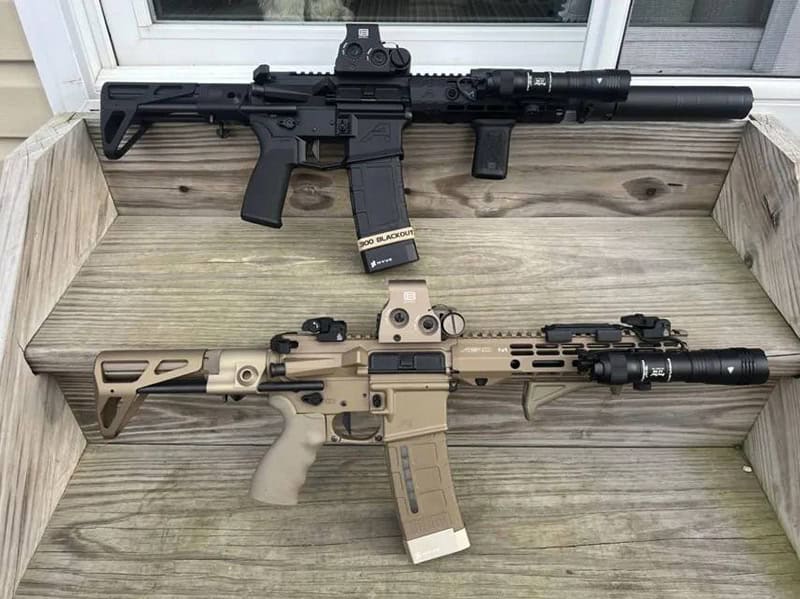
A 5.56 round is designed to burn its powder charge over 16 to 20 inches of barrel. .300 Blackout was engineered around the opposite assumption – a powder charge sized for a shorter barrel from the start. That single design choice is why the cartridge has become the default chambering for short-barrel AR builds.
An 8.5, 9 or 10.5-inch .300 Blackout upper placed next to a similarly sized 5.56 build is instantly apparent – less flash and a report that’s more manageable. None of that makes the gun hearing-safe (more on that below), but it’s the reason dealers have been seeing a demand curve for the past few years.
The Ballistics Case, By the Numbers
All short-barrel .300 Blackout discussions are about velocity retention, so it’s better to demonstrate than to state. According to Hornady’s published data, the 110-grain V-MAX
supersonic load is 2,375 fps from a 16-inch test barrel, with 1,378 ft-lbs of power. Hornady’s own barrel-length guidance estimates a loss of roughly 25-35 fps per inch of barrel removed for supersonic loads that are not tuned for subsonic use – so a 9-inch barrel should run in the 2,150-2,200 fps range with that load, still well over the sound barrier, and still carrying meaningful energy.
Subsonic loads are different, though: A 220-grain load such as Hornady’s Sub-X is engineered to remain subsonic at about 1,050-1,100 fps at the barrel length .300 Blackout is engineered into it, so the customer isn’t losing the performance they purchased.
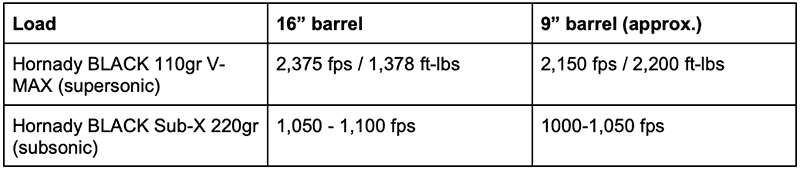
Figures are manufacturer-published averages and may vary from gun to gun;
recommend a chronograph session for customers who wish to
get confirmed numbers out of their specific gun.
Three build factors determine whether a short-barrel Blackout gun actually delivers this on the range, and they’re worth knowing well enough to explain at the counter:
Twist rate. A 1:7 or 1:8 twist is required to stabilize the 190-220 grain bullets used in subsonic loads. Older or budget uppers will have a 1:10 twist, which is suitable for heavy subsonics and is acceptable only if the customer remains strictly supersonic.
Gas system length. The reason that pistol-length gas systems are the standard on sub-10-inch Blackout uppers is that the dwell time – the amount of time the bullet spends in the barrel after it passes through the gas port – is already short on a barrel that’s this length, and a longer gas system (carbine or mid-length) can cause it to lose the pressure required to cycle reliably, particularly with subsonic ammunition.
Buffer weight. Reliable cycling with subsonic loads under a suppressor typically requires a lighter buffer than a stock carbine buffer – heavier isn’t necessarily better here, and many “my subsonic gun won’t cycle” complaints are not about the ammunition, but about the buffer.
What's Actually Moving on the Shelf
The correction worth making up front: when choosing Blackout ammo, the choice should be based on what is actually available, rather than what sounds authoritative. If you are looking for a paired recommendation, Hornady’s BLACK line is a clean example: the 110gr V-MAX for supersonic defensive and varminting applications, and the 220gr Sub-X for suppressed subsonic applications. In addition to that one brand combination, a well-stocked Blackout counter will have several manufacturers with supersonic options in the 110-125 grain range and subsonic options in the 190-220 grain range.
That depth is also the sales opportunity. A first-time Blackout builder has yet to find out what kind of supersonic or subsonic load their gas system and twist rate prefers, and a single box of each is better advice and a second sale. It’s a much easier discussion to have before the customer has already bought into a case of something that their gun doesn’t run well.
Choosing .300 Blackout ammo is a useful reference point for walking a customer through supersonic vs subsonic selection by intended use.
Magazines: The Cross-Sell Nobody's Pitching
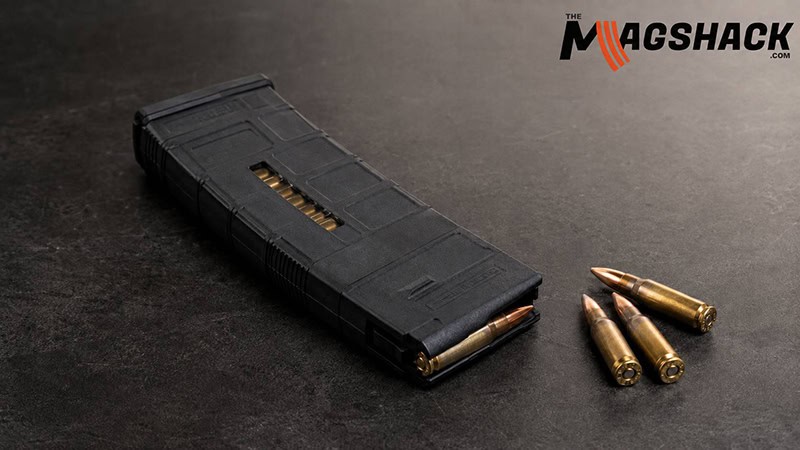
Simply put, the same magazine body that fits a 300 Blackout magazine also fits 5.56 is a true convenience – if a customer has a stack of PMAGs or Lancer L5AWMs, they don’t have to purchase a second magazine inventory to run a Blackout upper. But as with all things that bear a magazine retailer’s name, there’s a warning: a .300 Blackout will chamber in a 5.56 barrel. It will also fire. The outcome is a catastrophic overpressure event which can result in serious injury to the shooter and damage to the rifle. This is why Blackout owners who know what they’re doing dedicate or mark their magazines to one caliber only – and it’s not just a suggestion.
It’s also a simple second sale: a clearly marked collection of magazines for the Blackout upper is inexpensive protection against an incorrect sale, and it’s an easy sell at the register once the customer understands the importance.
On quality: poor-quality, loosely toleranced polymer bodies may not hold up to the heavier bullets of subsonic loads, and a loose feed lip can lead to nose-diving or short-stroking. That’s a good argument to recommend magazines that are made to spec for the caliber, and it’s not a criticism of all the aftermarket magazines on the shelf. Mentioning in the same catalog breath, though, worth noting, are Shield Arms’ steel-body magazines, which are designed for the Glock 43X/48 pistol platform, not AR-pattern rifles.
These options are available in the same 10-, 20- and 30-round formats that many customers are familiar with, in the .300 Blackout caliber.
Suppressors and the NFA Paperwork This Sale Actually Requires
Subsonic ammo cuts out the supersonic crack, so what’s left with a suppressor is mainly the sound of the gun working. If you match up .300 Blackout with a good suppressor (think SilencerCo Omega 300 or Dead Air Sandman-S), you really notice the difference. But it’s not, however, hearing-safe. Even with subsonic rounds and a suppressor, you’re facing around 120s dB at your ear, depending on which can and upper you use. That’s way lower than a bare centerfire rifle, but it’s still not safe for unprotected repeated exposure. “Significantly reduced” is the accurate claim here; “hearing safe” is not, and a magazine read by FFLs shouldn’t be the one making that leap.
And then there’s the paperwork nobody should ignore – especially not dealers. To buy a suppressor, the customer’s going to need a Form 4 transfer going through a dealer with SOT, or a Form 1 if they’re making their own NFA item.
Laws around suppressors and SBR uppers change state by state; plenty of states just ban them, so you have to cover that right away at the counter – not after they’ve paid. It’s on you to walk the customer through what’s legal and what paperwork is involved. Tracking how many Blackout builds go out with a suppressor attached tells you a lot, which is why dealers pay attention to it separately.
Optics follow the same short-range logic. A 1-6x or 1-8x low-power variable scope does the job for the distances you’ll realistically shoot this round and barrel length. Not a tough upsell if someone’s already in for the can and mounting hardware.
The Mag Shack: A Supplier Built by Shooters
The Mag Shack was founded in 2016 in Tallahassee, FL, with a simple mission: to provide gun owners with a reliable source for magazines and accessories at a reasonable price. It remains a 100% founder-owned business, and the team includes veterans and experienced shooters with years of experience in the firearm industry.
The core business is OEM and aftermarket magazines, but the catalog has expanded to include optics, furniture, PPE, and ammunition. The catalog is full of big names, including Magpul PMAGs, Lancer AWMs, Promag’s aftermarket lineup, and Shield Arms steel-body magazines. You will find 10-round mags here perfect for concealed carry in restricted states, as well as drum mags for a perfect range day.
Frequently Asked Questions
Is suppressed subsonic .300 Blackout hearing-safe?
No. It’s much quieter than an unsuppressed rifle, but that’s still too loud for regular shooting with no ear protection.
Can I use my 5.56 AR magazines for a .300 Blackout upper?
Yes, the mag body is the same. But you need to mark or dedicate mags to just one caliber. A .300 Blackout round will chamber and fire in a 5.56 barrel, with catastrophic results.
What twist rate does a .300 Blackout barrel need?
Go with 1:7 or 1:8 for stabilizing 190-220-grain subsonic bullets. The slower 1:10 works only if you stick to supersonic rounds.
What’s the ideal barrel length for a suppressed Blackout build?
Dealers usually say 9 to 10.5 inches is the sweet spot – short enough for a compact setup with a suppressor, but still keeps the supersonic rounds moving fast and subsonics performing well.
Conclusion
.300 Blackout didn’t just happen to dominate short-barrel AR builds. It solved a problem that 5.56 can’t handle at those lengths, runs in AR-15s most people already have, and handles a suppressor better than just about anything else out there. So for dealers, that’s a cross-sell in the magazine aisle, worth holding the ammo in both versions, and a conversation about suppressors that starts with the paperwork – always at the beginning.