Explaining The Need To
Carry Spare Ammo
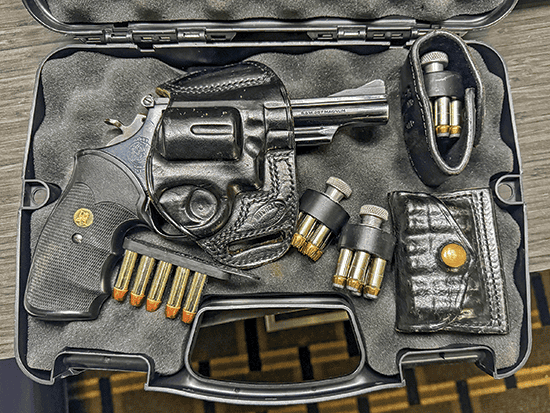
Speedloaders, SpeedStrips and 2X2X2 pouches are among the revolver
fan’s reloading options.
We all know accessory sales are an important part of retail sales, and this is as true of gun shops as anywhere else. In the personal-defense market, one too-often neglected accessory is spare ammunition and a way to carry it.
We’ve come a long way. Half a century ago, there were seven states where there was no provision for a law-abiding private citizen to carry a loaded handgun concealed in public to protect their family. Today, thankfully, there are none like that.
Back then, only a few states were “shall issue” in terms of carry permits. Most were “may issue,” which in many jurisdictions was a code term for “we’ll give you the permit if you’re white, rich and/or famous, male and politically connected.” By 2022, the majority of states were “shall issue” — and “may issue” became extinct with the Supreme Court’s Bruen decision.
Years ago, only one state trusted its law-abiding citizens and visitors to carry concealed without a permit required: Vermont. Today, the Vermont model of “constitutional carry” has spread to a majority of states.
Result: more Americans carry concealed now than ever before.
And a great many of them, perhaps a majority, carry just the handgun with no spare ammunition. They haven’t realized something I’ve told my students and readers for decades: A gun without spare ammunition is a temporary gun.
There is one glaring selling point for spare carry ammo we’ll go into first, and there are a couple of other very good reasons for the defensive pistol to be backed up with another magazine or two.
Wishful Thinking
“How much ammo should I carry?” is a common topic on online gun forums. On one such discussion thread recently, a commenter remarked he had been spooked by a carjacking involving five armed suspects and was thinking of switching to an auto from his usual revolver for higher capacity.
One supremely confident responder wrote something like, “Five bad guys? I have five shots in my J-Frame. No problem.” Ah, the power of wishful thinking!
At about the same time on the very informative site pistol-forum.com, readers, heard from Dr. Gary K. Roberts, a protégé of the late wound-ballistics expert Dr. Martin Fackler. Since Fackler’s passing, Roberts is generally considered today’s leading expert on the topic. Dr. Roberts wrote, “Looked at in aggregate over a multi-year period, the data breaks down like this: Approximately 1/3 of the time only one shot was needed to stop the threat. In another 1/3 of cases, 2–9 shots were required. Unfortunately, 10+ shots were necessary to stop the criminal aggressor in the final 1/3 of violent encounters.”
Dr. Roberts’ authoritative voice should be heard by anyone who thinks five bullets are going to instantly stop five violent aggressors.
Time In The Fight
The quintet of carjackers cited by the fellow I mentioned earlier was not a black swan event. Over recent years, we’ve seen gangs of similar size doing home invasions not just the one, lone nutcase of years past. In Chicago and elsewhere, a carload of armed bad guys, often with some wielding long guns, will pull up and emerge simultaneously to steal a driver’s car. If they decide to open fire, leaving the driver (your customer) alone with no choice but to return fire, the customer’s odds are bad enough without him having a limited supply of ammunition.
Take some advice from Tom Givens (rangemaster.com), one of the world’s leading instructors in defensive handgun use. He doesn’t speak of “firepower.” After studying countless gunfights, Givens calls the concept “Time in the fight.” He knows how fast a handgun can be emptied in a desperate situation and doesn’t want to be caught with an empty gun while his opponent’s weapon is still loaded.
Givens himself daily carries a full-size 18-round 9mm service pistol inside his waistband under an un-tucked sport shirt and two spare 17-round magazines.
Other criminal trends call for more ammunition than typical situations in years past. Consider:
The Armored Felon: More criminals are wearing bullet-resistant vests when they “go to work” than in the time of John Dillinger and Baby Face Nelson. That armor can soak up several bullets with no effect before the lawful defender realizes his or her first point of aim isn’t working and they have to shoot their homicidal attacker in some other, unprotected part of the body.
The Doped-Up Attacker: Today’s panoply of drugs of abuse sometimes give superhuman strength and endurance to the user, and/or extreme resistance to pain. It means the lawful defender may need several more shots to solve the problem.
The Skillful Attacker: Don’t assume your opponent doesn’t know enough to move and take cover — two things that will each require more shots from the lawful defender to solve the problem.
Some Pointed Reminders
Suppose your customer is one of the many who will reply, “I carry a fully loaded double-stack 9mm! I won’t need any more rounds than that unless there’s a zombie apocalypse!”
You and your staff might want to remind the customer other situations might demand spare ammunition. Ask the customer if his pistol has ever experienced a stoppage. If it did, when it happened did the barrel peel back like a banana in the manner of Elmer Fudd’s shotgun when Bugs Bunny stuffed a carrot down the barrel? Or did the “jam” have something to do with the magazine or the cartridges therein?
If, say, a round nosedived in the cartridge stack, the best way to get the gun back up and running in a life-saving emergency is to get the bad mag out, another good one in and go back to returning life-saving gunfire.
If the revolver’s cylinder won’t turn, there’s no time to isolate which defective cartridge has a high primer. Dump the whole cylinder-full, slam in a fresh speedloader or moon clip and get back to shooting.
Finally, remind your customer in a struggle for the gun, the assailant’s hand may hit the mag-release button and send the full magazine off into the dark, the snow or the mud. When he gets the pistol back it’ll be a single shot, or utterly useless if it has a mag disconnector safety — unless he has a spare mag he can slap in to make the gun work again.
Learn From The Cops
America’s armed citizens have historically modeled their defensive handguns on what the nation’s police carry. Back in the day when street cops carried .38 Special or .357 Magnum service revolvers and plainclothes officers wore snub-nose .38s of the “Detective Special” genre, those were also the most popular guns for home defense and licensed concealed carry, respectively.
Now, at the same time most “civilians” are packing (usually 9mm) autos, the cops have gone from a six-shooter with 12 spare cartridges to an 18-shot 9mm and two (or even three) spare mags. Remind the customer there are sound reasons for this.
The customer will ask how you expect them to carry spare ammo in discreet concealment, and with comfort. We’ll share some helpful tips in this column, next month.