The State of Previously Owned Firearms

Image: JackF / Adobe Stock
There are plenty of items you wouldn’t want to buy “used,” but quality firearms shouldn’t be among them. There are several benefits to purchasing a “previously-owned” firearm, the most obvious being significant cost savings. The second-hand market may offer access to a wider range of rare and discontinued models, and some shooters will argue that it can be “broken in.”
The biggest consideration is how “used” a particular firearm may be.
Used Or Abused
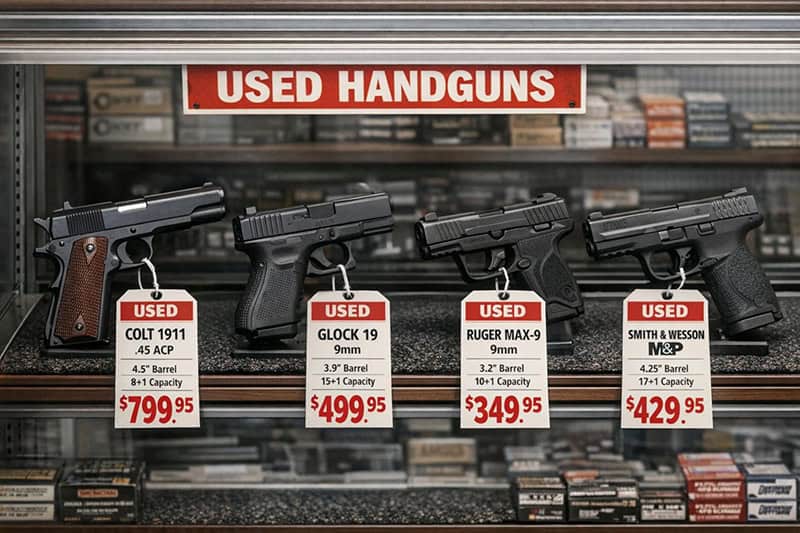
As with many products, there can be a major difference between used and “used and abused.” Most shops won’t sell firearms that are in the latter category, and certainly won’t buy such guns from customers.
“When we look at used guns that a customer brings in, we want to see that it is clean and not shot out,” explained Dustin Castaline, co-owner and manager of Wyoming Guns and Hunting Supplies in Homosassa, Florida.
Another advantage is that used firearms can retain their value, unlike brand-new offerings that can depreciate immediately after purchase. Well-maintained used guns can often be a sound investment, and consumers can also find models that come with aftermarket upgrades.
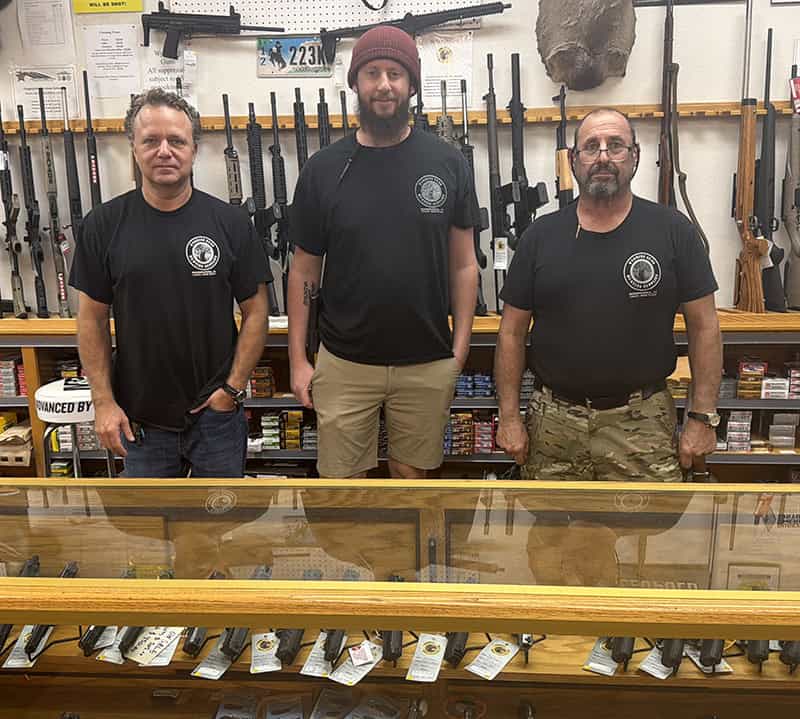
The team at Wyoming Sporting Goods in Homosassa, FL
State of Sales For Used Guns
As with everything in the firearms world, interest in used guns can fluctuate significantly, but now may be a good time for retailers to stock up. Budget-conscious consumers are more likely to look at what is in the used cabinet than at the brand-new offerings on the wall or shelf.
“Used gun sales are strong now, and were strong after Christmas,” said Paul L. Jacobson, CEO of Jacobson’s Gun Center in Story City, Iowa.
“Buyers are looking for fair prices, good quality, good condition, and a mechanical guarantee,” Jacobson told Shooting Industry.
For Tom Matthews of Howell Gun Works in Howell Township, New Jersey, used handguns were strong sellers in early 2026.
“The majority of buyers are looking for a first-time concealed carry 9mm size handgun,” Matthews suggested. “For rifles, it’s almost always a used AR-style rifle.”
However, there weren’t really any particularly “hot-selling” firearms in the Garden State, but that hasn’t kept the bargain hunters away.
“We are finding a majority of customers to be first timers, just like COVID times. And, they are looking for an economical purchase,” Matthews explained. “Truthfully, I can’t blame them, given the economic times. In New Jersey, utility bills are through the roof, along with taxes and insurance. So most people don’t have a slush fund for firearms and ammo right now.”
Down in the Sunshine State, Castaline commented that sales were really good last year, driven by Florida’s removal of sales tax on hunting, fishing, and camping-related items that lasted from September 8 to December 31, 2025.
In the nation’s heartland, no particular brands or models stood out, except for one category that saw a decline likely tied to the end of hunting season.
“There do not appear to be any exceptional selling items, except that shotguns are slower now than they are in November to December,” Jacobson added.
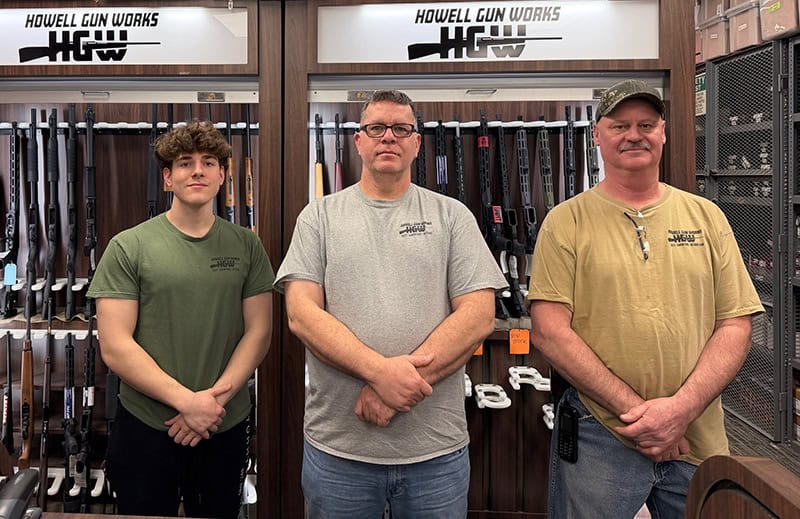
The team from Howell Gun Works: Dylan Matthews, Tom Matthews and Bill Gratton.
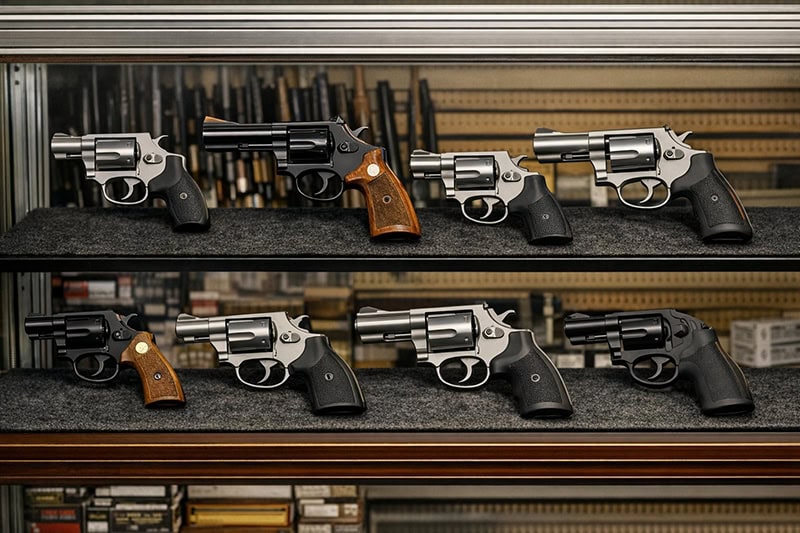
How Shops Determine What to Buy?
Shops that purchase used firearms for resale will certainly want to consider condition, but after that, it comes down to price. Retailers will quickly learn what can be “flipped” quickly to a new buyer and what might end up in the gun safe for weeks or, unfortunately, even months before it finds a new home.
It is also important when dealing with firearms to watch for trends, such as when clients are looking to sell as much as when they are ready to buy.
“We saw a lot of guns come in after Christmas,” Castaline added. “It could be that many of the customers were trying to get money to buy the new firearms that were introduced at the SHOT Show. A lot is coming out this year, and that was likely driving some to sell the guns they weren’t shooting as much.”
Determining the price is trickier than dealing with new guns, which have a dealer price and an MSRP.
“We purchase any gun that we can agree on a price with the seller,” said Jacobson.
There is a need to ensure that both parties come away happy with the deal, as shops don’t want a bad reputation for offering “low-ball” prices only to drastically mark them up.
“I need to make money but don’t want to screw over the people in the community, as those are my regular customers,” said Castaline. “If it is a really rare gun or something special, we’ll happily pay more to get it.”
Unfortunately, there will be times when the owners of firearms see the retail price and use that as an indicator of what they think they deserve.
“Some people may want full value,” added Castaline. “We need to reach that point where we can still make money.
In some cases, we can take it on consignment.”
Taking a firearm on consignment opens another avenue for both the customer and the shop, but Matthews indicted the terms need to be very clear.
“When a customer comes in looking to have a firearm sold, we offer a retail value on the gun, then a consignment cost and straight purchase cost,” Matthews continued. “Two-thirds take the immediate buyout.”
In the end, it is about maintaining the relationship so everyone is happy.
Claim Your Advantage Every Week!
By submitting this form, you are consenting to receive marketing emails from: . You can revoke your consent to receive emails at any time by using the SafeUnsubscribe® link, found at the bottom of every email. Emails are serviced by Constant Contact