310
Show Customers Where To Carry Spare Ammo
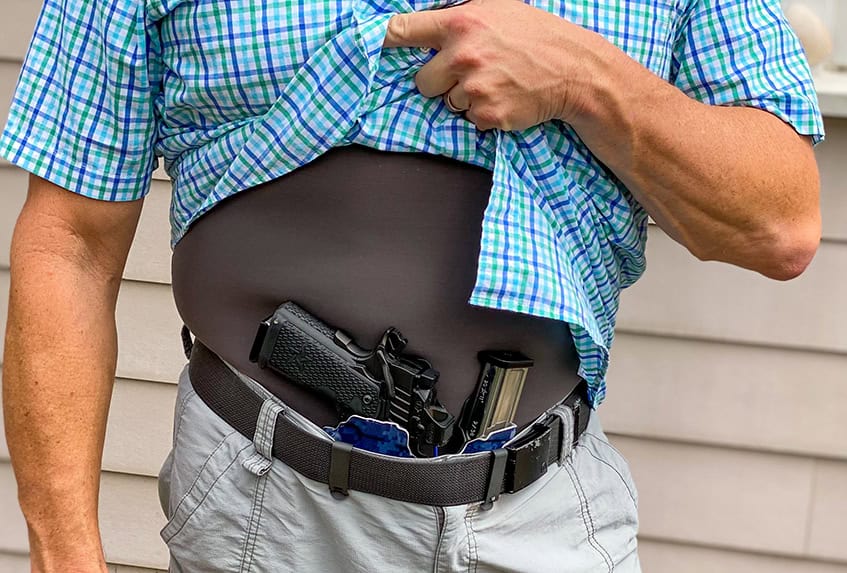
If you can convey value and function, sales of accessories — like spare magazines and holster systems
equipped to carry them — will follow. (Image: Tom McHale, American Handgunner Concealed Carry 2022)
Accessories sell when their value and function are explained. This holds true for convenient, accessible spare ammo carry options.
As we discussed in this space last month, a defensive firearm without spare ammunition is a temporary defensive firearm. Legendary gun expert John Farnam established way back in the 1970s the average person can fire a double-action revolver at a rate of four shots per second and a semi-auto, with its shorter trigger pull and trigger return, at about five rounds per second. This can leave an embattled armed citizen with an empty handgun awfully quick.
World champions can shoot as much as twice as fast. Go to YouTube and look up the video of Jerry Miculek emptying an eight-shot Smith & Wesson revolver in one second flat. If you’ve found the whole video, you’ll notice all eight shots are hits.
“Not to worry, I carry a spare box of ammo in my glove box” is a sub-optimal answer at best. The likelihood of getting to the box in the first place, opening it and getting the cartridges into the gun (or into the magazine and then into the gun) is probably somewhere between slim and none.
This point was made by the surviving agents in their debriefing after the legendary April 11, 1986, gunfight between the FBI and two committed armed robbers and cop-killers. Its title is “Firefight,” which you can also find on YouTube. One of those heroic agents, Ron Risner, was asked how much ammo one should carry, and he replied, “All you can carry.”
With home-defense long guns, it makes sense to have the ammo right there attached to the gun, all the more so for your customers who had to make the compromise with their spouse if a gun was to be kept in the house at all, it would be kept unloaded. As far back as WWII, American combatants issued the M1 carbine had access to a canvas pouch that went over the buttstock and held a couple of spare magazines.
With today’s defensive carbines, various companies make clips capable of holding two magazines together, and the Redi-Mag (redi-mag.com) is particularly useful for the ubiquitous AR-15.
For shotguns (and for the lever-action carbines that seem to be enjoying some resurgent popularity as defensive firearms) there are the various butt cuffs for spare cartridges that attach to the stock. You probably already offer the Side-Saddle and similar devices that hold shotgun shells on the receivers of pump and autoloading shotguns. All good.
Most DGUs (armed citizen Defensive Gun Usage) involve handguns, however. Let’s look at those.
Semi-Auto Pistols
One of the autoloader’s advantages is its fast reloads, with magazines compact enough to be discreetly and comfortably carried concealed. Those with flap covers are sub-optimal for defensive concealed carry.
The digits of the support hand have to claw between the magazine and the leather or fabric of the flap to gain a proper grasp of the magazine: fumble-prone and achingly slow.
Show the customer how much more quickly and surely they can withdraw the magazine from an open-top, friction-tight pouch whether it’s made of leather or Kydex.
One reason so many concealed carriers don’t have spare ammo on their person is they find it inconvenient. Sell such customers magazine pouches that clip on and off the belt without having to unbuckle anything. Early versions of these earned a poor reputation because their weak clips often came loose, causing the pouch to come out along with the magazine when the user was attempting a reload.
I recall interviewing a detective in Southern California who, years ago, had a shootout with a serial rapist. The officer had been wounded in his gun arm by a .380 slug from the criminal’s gun, and when he went to reload his Colt .45 auto, the mag pouch came out with the magazine. He would forever after remember the frustration of having to clear the magazine from its leather carrier and get his weapon back into action.
Fortunately, he did so and finished the fight. He recovered from his wound, and the rapist and would-be cop-killer died at the scene. The detective was thereafter much more selective in the purchase of his gun accessories.
Mag Pouches & Shoulder Holsters
Today, we have mag pouches of both leather and Kydex with much more secure belt clips. They are convenient to put on and take off, and so long as they are mated with a belt of proper corresponding width, they will hold the magazines comfortably, securely and discreetly against the wearer’s body.
Single or double pouch? With a thick double-stack magazine, a single mag pouch is more discreetly wearable. Slim single-stack magazines à la the 1911-type ride very comfortably and concealably with two of them mounted side by side. My favorites include the Blade-Tech brand for a pair of flat 1911 magazines and the single mag pouch for double-stack magazines from Precision Holster.
Does your customer wear a shoulder holster? When Richard Gallagher founded his original holster company in 1969, now famous as Galco, he pioneered the “shoulder system” in which the holstered handgun on one side was balanced by ammo pouches under the opposite arm. It has become one of the most widely copied designs in the holster industry. Magazines ride quite comfortably there, with reasonably quick accessibility.
Sales tip: Remind your customers a shoulder system with pistol and magazines ready to go — perhaps with a good flashlight clipped to the harness — gives them a full set of gear they can quickly shrug on like a jacket when the burglar alarm goes off.
Neil Rogers was an FBI agent when he created the SnagMag to hide a spare mag accessibly in a pocket. This handy device is now available through 1791 Gunleather.
Revolvers
The double-action revolver is enjoying some renaissance in popularity today. One reason it has been so decisively eclipsed by the auto pistol is its lower cartridge capacity; the ability to quickly reload helps to make up for that.
For bouncing around and vibrating in a vehicle’s glove box, the venerable and ubiquitous HKS Speedloader is still unbeaten for ruggedness. The Safarilands, which release with just a push instead of a turn of a knob like the HKS or Five Star brands, are faster. The fastest are Safariland’s Comp III or the Jetloader, but they’re bulkier. It’s still manageable, though. When I carry a revolver as primary, I find a Comp III works just fine in the smartphone pocket of my cargo pants.
Since a speedloader is about the diameter of the cylinder of a whole additional revolver, concealment becomes a concern. The “split-six” type carrier has the cartridges straddling the belt, three inside and three out for a lower profile. Open on the sides with a flap at the front, it allows the user to grasp the loader with the middle finger and thumb through the open sides and pop the flap with the index finger.
A favorite of plainclothesmen when revolvers were standard was the flat, inconspicuous 2X2X2 cartridge pouch made by DeSantis and others. Instead of flopping down and dumping all its cartridges into the hand, this improved design tilted forward from the belt and offered easy loading of two cartridges at a time. They are still available and still make sense.
A slide with cartridge loops can be reasonably fast, if, like the Bianchi version, the loops are at the very top of the slide. This design allows the tips of the index and middle fingers to push the cartridges up where the thumb has access, allowing two at a time loading. Carried at the front of the belt, they glaringly reveal the wearer is armed if the concealing garment is open, but a closed front garment such as a loose T-shirt or hoodie hides the loop slide very well. For legal open carry, of course, it won’t be a concern. One of the best is the two-round Greg Ellifritz design from Dark Star Gear (the Immediate ActionCarrier .38-357).
A perennial gun shop “impulse sale” item is the Speed Strip, pioneered by John Bianchi and still available along with the similar TUFF QuickStrips. Faster than drop pouches but not as fast as speedloaders, the strips are handy because they are very flat. They can fit in the watch pockets of typical jeans, and the business card pocket typically sewn into the right front pocket of suit coats and sport coats.
To close as we began, a gun without spare ammo is a temporary gun. Selling spare ammo carriers is profitable to the gun dealer … and can prove to be a lifesaver for a customer.