Profits At The Range
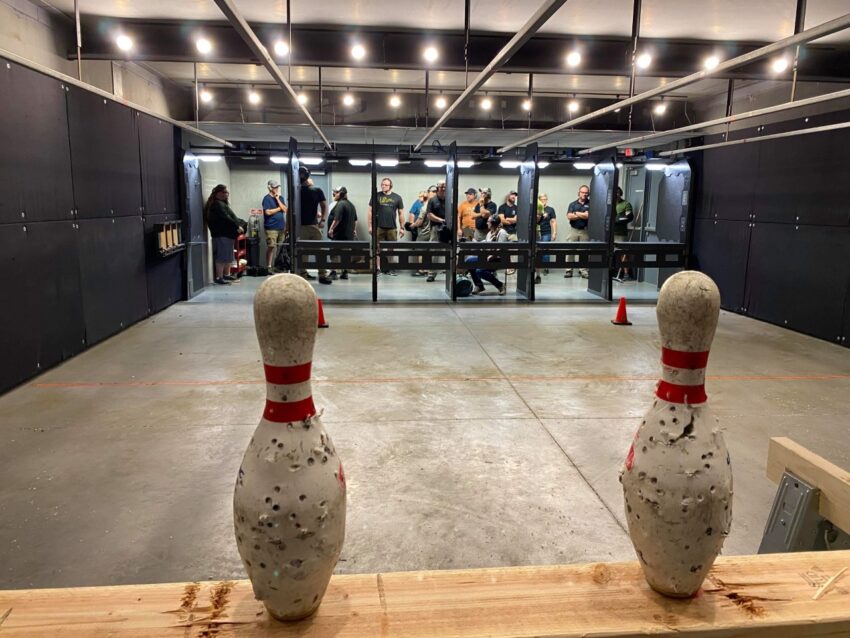
Marksman Indoor Range offers several bowling pin and pinhead shoots each month —
and they sell out briskly.
A bowling pin isn’t necessarily the kind of thing that grabs the attention of customers strolling through a gun store. Unless, of course, the pin is riddled with bullet holes.
In this case, it tends to draw more than a few looks and questions from customers who wonder aloud: “Can I shoot a bowling pin in here?”
It’s just the sort of reaction — and conversation starter — they’re hoping for at Ultimate Defense Firing Range & Training Center in St. Peters, Mo. Every customer who walks through the front door knows they can shoot at the range. But they don’t necessarily know about all of the different ways they can do it.
“Some people need a reason to shoot,” remarked Paul Bastean, managing director of the suburban St. Louis shop. “We do everything we can to provide the reason for them, whether it’s self-defense, entertainment, stress relief or whatever.”
It’s the great thing about having a range. With some imagination, you can turn it into much more than a place for customers to spend an hour honing skills or testing out a new gun. To be sure, stores with larger, more modernized, ranges have greater flexibility. For many shops, however, the range is the heart of the business.
Get Creative
At Ultimate Defense, creativity is what keeps customers coming back, and it allows the store to match changing needs. Customers’ desire to work on self-defense skills is a constant draw, but Bastean has also seen a gradual shift toward shooting as a form of entertainment. They cater to this shift by offering fun options.
Those options come in different shapes and sizes. They have live demonstrations to show what happens when bullets strike ballistic gel. They’ve brought in doors and walls and shot them with different types of bullets to demonstrate penetration. They have a gun-of-the-month competition where customers shoot cartoon targets (a turkey at Thanksgiving, for example) for chances to win a gun drawing. And of course, there are various competitions, including the bowling pin shoot.
“Creating that intrigue and making people want to participate in your range is the key to success,” Bastean said.
It also helps to be flexible, suggests Thom Beyer, director of operations at The Range in McKinney, Texas.
Just because you have individual lanes, it doesn’t mean you can’t open things up with special events allowing customers to move further down range and shoot multiple targets — even on the move.
“It really excites people to go on the other side of the firing line and to be able to shoot in an attacking mode,” Beyer shared. “They like to do move-and-shoots and train beyond just standing there.”
The relatively new range is equipped with tablet-controlled targets, allowing customers to change courses of fire with the push of a button. They also installed police lights in the baffles — both as a training aid for law enforcement/security and occasional fun for customers who can experience shooting in a distracting environment.
Simulators Bring Mixed Results
Figuring out which of the newer range technologies — including simulators, virtual reality and smartphone-based apps — can be a challenge, however.
The Range invested in a simulator that has had mixed results. As a pure training tool (it doesn’t offer waves of zombies or other fun scenarios),it has limited appeal to regular customers. Back in Missouri, Ultimate Defense has looked into the technology but isn’t convinced it can be monetized.
Bastean likened the simulators to video games that quickly lose their appeal for players.
“They play the game until the end, and then they’re done. They don’t play with it anymore,” he said.
The answer might be with systems that demand less in the way of upfront capital investment.
Marksman Indoor Range in Waterloo, Neb., is testing out a system by Target Eagle that combines special targets with an app installed on the shooter’s smartphone. The system scores the target for the shooter, allowing the results to be uploaded and compared with those of other shooters.
“It will give you immediate feedback on how you’re shooting and it will provide an opportunity to shoot in a league where everybody comes in at their leisure and shoots the same target or same course of fire,” commented Jessica Ulrich, co-owner. “You could be competing against a buddy who lives out of town.”
Driving Traffic
The range also serves as a powerful engine for keeping customer interest during those times of year when business slows down. For Marksman Indoor, this means a heavy dose of classes during the summer months when people are distracted by outdoor activities.
“We really fill up the calendar during the summer months,” Ulrich said. “With the whole range being slower, we want the classroom to really thrive.”
During June, for example, they offered classes on 17 days of the month, with an emphasis on handgun fundamentals and concealed carry classes. Something to keep in mind, she points out, is they have had great success offering classes for women only.
Along with having females on staff, these courses — which are among the first to sell out — have helped expand the store’s customer base.
“This demographic is booming,” Ulrich relayed. “If I look on my social media, almost 40% of our clients are women.”
Interestingly, one of the positive developments for people who want to carry a concealed firearm hasn’t been a great thing for training. With more than half of U.S. states having laws allowing constitutional or permit-less carry, the need for concealed carry courses — at least from a legal perspective — has dropped substantially in many areas.
When the change was made in Missouri, there was a noticeable impact on demand for training courses at Ultimate Defense, noted Bastean. And it wasn’t just the beginner- type classes that dropped off. Often, the students in those courses would come out asking about the advanced classes offered by the range.
“It’s very much a leader into our other training courses,” he noted. “When we see a reduction in the amount of people coming into the entry course, we see a wave that goes through all of our training.”
Membership Has Its Privileges
Range memberships can also help boost traffic during slow times. At The Range in Texas, they have a variety of memberships, covering individuals, families, first responders and professional trainers. They also offer a deal aimed specifically at drawing in customers during off-peak hours.
The store’s silver membership is available for people over the age of 65, offering access to the range Tuesday through Friday.
“This fills the emptiness during the day,” Beyer said. “It’s been kind of neat. We’ve built up a group of guys who come in and shoot together. They’ll shoot for 20 minutes and then drink coffee and have social time for two hours.”
More than that, though, memberships convey a sense of belonging to customers. This comes out in a variety of ways, including having range priority over nonmembers, discounts and free gun cleanings.
“They just enjoy being able to set down their card, get their target, go in and shoot and then walk out the door,” he explained.
At Marksman Indoor in Nebraska, Ulrich touts memberships as a way to gain a commitment from customers, who are far more likely to return to the store and range if they’ve paid the annual fee.
“They’ve invested the money. Ideally, they’ll be here weekly training and getting in front of us,” she maintained. “In turn, it builds sales for us every time they walk in the door. It could be a box of ammo, targets and an opportunity to tell them about courses and events.”
It’s also difficult to overstate the pure monetary boost provided by memberships. At Missouri’s Ultimate Defense, membership offerings include both annual and monthly options. Currently, the monthly option is proving to be the easier sell. It’s certainly noticed each month when those payments come in.
“It’s kind of the foundation on which everything else is built,” Bastean stated. “Having that massive drop of cash on the seventh of every month — it’s just a party.”
Getting The Word Out
If potential customers don’t know about you or your range, it doesn’t really matter if you have one. Figuring out the most effective way to reach people can be one of the most significant challenges, particularly if you are operating on a small-business budget.
Ultimate Defense has had good luck with local billboards along area highways, while radio has been a disaster. The Range, in Texas, has driven traffic with ads in a small circular delivered to all of the homes in the area and its own outdoor signage. And Marksman Indoor, with a limited marketing budget, relies more on word of mouth and social media.
Social media, of course, has been a frustrating puzzle for gun stores. But there have been signs this year of a softening of some of the rigid, and often difficult to interpret, restrictions on Facebook. Ultimate Defense has noticed a drop in the frequency of violations generated by antigun complaints that would often follow the store’s Facebook posts. They haven’t tried mentioning gun prices on the platform, but regular marketing and informational posts have fared much better lately.
“We’re happy to be able to put our training and other stuff out there because people really are not going to Facebook to buy,” Bastean said. “It’s about getting people in here for training, keeping them up on current events and putting some stupid stuff out there that makes them bookmark it for the future.”