Think “Beyond The Gun”
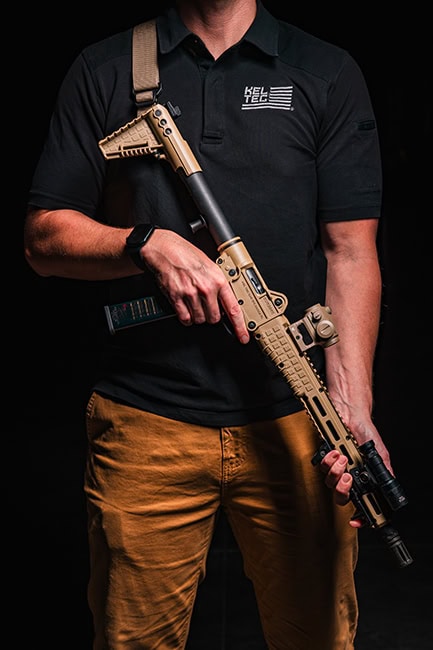
Just sold a KelTec SUB2000 GLK 10mm carbine to a customer?
Accessorizing options abound: lights, sights, slings, magazines
and more. Make sure your team capitalizes on expanding the sale!
(Image: KelTec Weapons)
The wise firearms dealer sells more than guns and ammo.
Just as an infantryman needs support personnel backing him behind the lines, the defensive firearm requires holsters, carrying cases, secure storage and maintenance supplies.
Guns aren’t the whole answer to self-protection. The firearm in the defensive context represents lethal force, the highest band on the personal threat spectrum. Most people are less likely to need a lethal weapon than they are to remove an offending hand, prevent a punch or kick or persuade an aggressor to keep his distance. This opens the door to a deep array of personal security devices that fall into the “less-lethal” category.
Support Gear
The Holster Wardrobe: Many first-time gun buyers think they only need a firearm and ammo. After all, they’re going to stick it in a drawer or closet. They have to be gently, persuasively reminded this gives them limited protection. A gun at home in the proverbial sock drawer is not only vulnerable to theft by burglars, but totally useless when the legitimate owner is out and about in public.
The customer probably doesn’t wear the same clothes every day in all seasons. The carry gun, by definition, is something they wear. The holster wardrobe might include something like the excellent PHLster Enigma system, the ultimate evolution of a belly band, which hides a reasonably sized handgun under tucked-in shirts or other professional garb while keeping it instantly accessible yet completely concealed.
In jacket weather, a faster access holster carried appendix under a hoodie or at the hip covered by a garment will be more accessible and may allow comfortable carry of a sidearm that might be larger, more powerful and/or capable of holding more ammunition.
Might the customer have medical issues, such as a bad back or hips? In this situation, a shoulder rig becomes an “orthopedic holster” that takes weight off the hip or sciatic nerve and stops the pain. Is the customer constantly seated behind a desk or steering wheel at work? A small handgun in an ankle holster might be the ideal choice for that application.
Weapon Security: If the customer says, “I keep a loaded gun in every room in the house; they’re safe there,” he should perhaps be encouraged to do some re-thinking. If his house was that safe, why did he realize he needed loaded guns therein in the first place? Imagine coming home to find a burglar already there, now armed with the customer’s own loaded gun he easily liberated from that sock drawer?
Sales tip: Have quick-release lock boxes right there by the counter to demonstrate. Key, quick push-button combination and biometric release are the choices.
If the customer keeps a “car gun,” remind him or her glove boxes and consoles are not particularly secure. As the late master instructor Pat Rogers used to say, “Your car is not your holster.”
Every year, many guns are stolen from automobiles. None of us wants the guilt trip of getting a call from a police department saying our gun was used to murder an innocent victim. There are many discreet, quick-release lock boxes that can be chained to the vehicle. These will be particularly handy for your customers who routinely carry concealed, but have to go in and out of legally “gun-free zones” such as Federal buildings and courthouses. They’re natural buyers for these items.
For the many homes protected by loaded carbines and shotguns, have a long-gun rack for sale with a quick-release lock that can be bolted to the floor or a wall stud in a closet or a corner of the bedroom.
Sight & Sound: If there is a dangerous intruder in the home, the resident wants to be able to see and hear the bad guy as soon as possible. One option is a pair of active hearing protectors kept near the home-defense gun that can be slapped on when the homeowner retrieves the weapon.
The best of these, such as the Warbird brand (which I prefer), can amplify sound. Of course, if it does come down to gunfire, hearing protection keeps the deafening indoor reverberation from reducing a primary sensory acquisition at the worst possible time. Finally, remind the customer when they face an armed intruder with a gun in hand and earmuffs on, the intruder has a really good reason to believe, “Uh, oh — the homeowner’s not bluffing!”
White light, of course, is a natural addition for a home-defense firearm, handgun or long gun. I’m sure you already have these in stock. Just remind them if they use it for searching, they’ll be pointing a loaded gun at everything they see, including any unexpected loved ones. They want a separate flashlight for search.
Let’s talk about flashlights. If Miss Manners never said, “You can’t be too rich, too thin or have too many flashlights,” she probably should have. Gun people tend to be gadget people, and that’s fine so long as the gadgets are reliable and useful.
Current designs like the SureFire Stiletto and the Streamlight Wedge carry easily clipped in a pocket, are flat and discreet and give ample light output. The possibility of home invasion aside, electric power can go out anywhere. One of my graduates was in the Twin Towers on 9/11 and still remembers the terrifying descent through endless stairwells in pitch darkness. He swore he’d never be without a flashlight again, and when I last met him, he was carrying two SureFires all day, every day.
“Less Lethal” Defense Thinking
I put “less lethal” in quotes because so many people, upon hearing the phrase, sneer at it. In actuality, it simply means tools intended to restrain violent people with minimal chance of killing or crippling them.
In some jurisdictions, the civilian version of the TASER is legal to sell, though it’s a bit awkward to carry. Avoid the so-called “stun guns” that require at least five seconds of uninterrupted contact to be effective. If the customer can hold a strong, violently resisting bad guy for five straight seconds, they can probably restrain him without tools.
Pepper spray is almost universally recommended. The SABRE brand has always had a good reputation, and today I see more professional pepper spray instructors recommending the POM brand than anything else.
Sales tip: Remind the customer, ideally, they want a wardrobe of pepper spray dispensers, too.
The fogger type is good for quick reaction at very close range, but may not be ideal outdoors in strong winds. The streamer type gives a longer range but requires more accuracy to get the stuff in the bad guy’s eyes. Some of your customers might have respiratory issues and fear cross-contaminating themselves with the spray. If so, a foam unit will minimize cross-contamination. Finally, an inert drone unit for practice is also a good idea.
Self-defense requires a broad spectrum of responses to ward off a broad spectrum of dangers. The more options the dealer offers the customer, the better protected the customer will be, and the better job the dealer will have done to keep his or her patrons safe.