Value In Budget Guns For Self-Defense
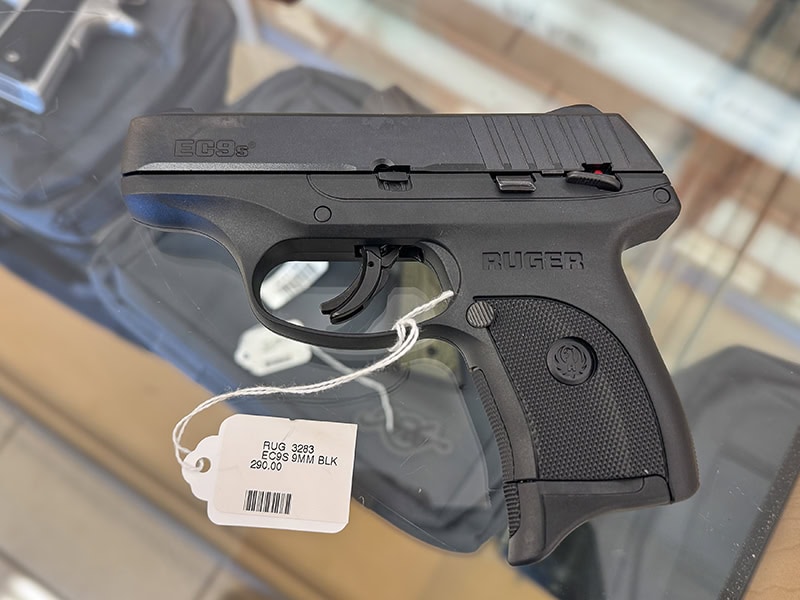
Today’s budget-minded customer is tomorrow’s regular customer whose purchases are likely to
increase in value. At under $300, Mas considers the Ruger EC9s a “best buy.”
When I was a young guy just starting out, I mostly bought used guns because I was far from peak earning years and they were all I could afford. The dealers who were able to accommodate me and treat me with the same courtesy and dignity as the rich guy ordering a Perazzi shotgun were the dealers I appreciated and brought my business to when I earned more money and could afford premium firearms.
This is a syndrome well recognized in marketing. Today’s satisfied Chevy buyer is tomorrow’s Cadillac customer at the same dealership. It serves any retailer well to cultivate that market.
It’s “Ethical Marketing”
There’s also the concept of ethical marketing to consider. Back when the anti-gun forces hadn’t created their “assault rifle” BS yet, they focused on banning the cheap handguns they called “Saturday Night Specials.”
We in the gun owners’ civil rights movement fought them on the grounds poor people who could only afford a cheap gun had every bit as much right to one as the rich customer who could easily afford a high-priced Colt Python.
And they probably needed it more.
Who was in more daily danger, the customer who drove his expensive new car home from the office to his gated community at the end of every afternoon, or the minimum wage cleaning woman who had to walk home through a high-crime inner city neighborhood at night?
This same concept of ethical marketing makes another demand upon the firearms retailer, one which I’m sure you’re already living up to: Don’t sell them junk just because they want low prices. The new target pistol that jams will cost the customer a trophy and the new hunting rifle that locks up will cost the woodsman a deer, but the defensive firearm that malfunctions at the moment of truth can cost the customer who trusted us their very life.
One option, of course, is promoting layaway purchases. The only problem there is the person who has been threatened and needs a firearm now. If you don’t care to get into the hassle of financing, look around for finance companies that offer small loans and see if there might be one or more you could recommend to customers who are long on need but short on money.
Let’s look at some other options. It breaks down primarily into two categories: low-priced new firearms and pre-owned specimens of more expensive guns.
New Firearms
In the mid-1950s, Sears, Roebuck & Co. had their famous Good/Better/Best levels of all sorts of products, each commensurate in terms of price, quality and value. The Chevrolet division of General Motors, then America’s best-selling brand of automobile, did something similar. Their full-size cars were available as the stripped-down Biscayne, the Bel-Air with somewhat nicer appointments and the top-of-the-line Impala with all the proverbial bells and whistles.
Smith & Wesson took a page from them all. Circa 1954, they introduced their first modern economy-grade gun, the Highway Patrolman, later known as the Model 28.
At a time when their flagship revolver was the deluxe heavy-frame .357 Magnum, later known as the Model 27, they built the same gun without checkering on the top strap, checkered walnut grips instead of exotic wood and a flat sandblasted finish instead of their famous Bright Blue. The Highway Patrolman initially sold for $75 instead of its fancy progenitor’s three-figure price tag. The new economy-grade .357 was an instant best seller.
It set a trend: a plain vanilla version of the famous, expensive product, but cheaper.
Remington would follow with the Express version of their popular 870 Wingmaster pump shotgun and Winchester with the 670, a plainer version of their Model 70 rifle.
Today, the big companies no longer make plain-Jane versions of their top-line guns but instead use other designs that work well but are cheaper to produce as their offerings for the low-price market. Why? Probably because the economy versions of the top-line guns were seen as cutting into the more profitable sales of the latter. It doesn’t mean today’s lowest-price guns from name makers are bad.
In shotguns, consider Mossberg’s Maverick 88. Assembled at a factory in Eagle Pass, Texas, with some components made in Mexico, it distinctly undersells Mossberg’s U.S.-made 500 and 590 models. Its slide action is reasonably smooth, it has a cross-bolt safety on the front of the trigger guard like a Winchester instead of Mossberg’s trademark top tang safety and most importantly, it has earned a reputation for reliability.
It would be my first recommendation for a home-defense gun for a customer long on need but short on cash. Price tag at my local gun shop: $275.
Rifles? That same gun shop has multiple AR-15s for $550. I’ve seen a lot of the Palmetto State Armory AR-15s come through my classes and while they don’t have the panache of a Colt or Daniel Defense, they work fine.
Handguns? S&W’s approach is now to hit the economy market with their SD9, the latest evolution of their Sigma design from the early 1990s. $320 before sales tax, and they work. The Smith & Wesson name has always smacked of quality.
The same is true of the Ruger name, one synonymous with “good guns cheap” since the company was founded in 1949. Their GLOCK clone made in partnership with Magpul, the RXM, does everything the more expensive striker guns will do for around a $400 retail price point.
Want to go less? A real bargain is Ruger’s EC9s pistol for under $300. Dealers are also selling a lot of Taurus G3 (standard size) and G3C Compacts in the $300 range, and these guns are working better than the Millennium series which preceded them, in this writer’s opinion.
Don’t neglect revolvers, particularly for new shooters who might be better served by their simplicity. In recent years, Taurus has markedly improved the quality of their revolvers: Their Model 856 is getting rave reviews. Heritage, maker of super-cheap but functional single-action .22 plinking revolvers, is selling the hell out of their new Roscoe, a copy of the classic Smith & Wesson Model 36 .38 Chief’s Special that sells for way less than the original.
Use Guns
The boomer generation is dying off, and their heirs are taking their collections to gun shops to sell. Another source is traded-in police weapons. Remember how cheap S&W, Ruger and Colt .38 Special and .357 Magnums were during the great sea change from service revolvers to semi-auto duty pistols? And .40s being traded dirt cheap for 9mms more recently?
The current trend to 9mm service pistols that accept carry optics has created something similar in the here and now.
If your shop doesn’t supply law enforcement agencies and take their old guns in trade, reach out to distributors that do. Right now, AIM Surplus is offering perfectly functional S&W M&Ps, SIG SAUER and Gen3, Gen4, and even Gen5 GLOCKs in the $300–400 price range.
Today’s budget-minded customer is tomorrow’s regular customer whose purchases are likely to increase in value. It’s probably also good karma to arm good people who need to protect their families, no matter the size of their bank accounts.