Save Face With Your Retail Space
“Facelifts” Attract New Shooters
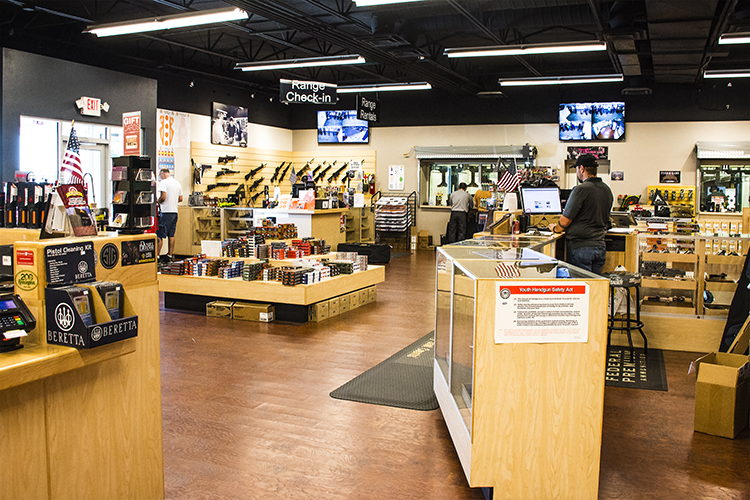
At Calibers Shooting Range in Albuquerque, N.M., a bright, clean layout
presents a welcoming experience to new and established customers alike.
Musty, dark, chintzy, cluttered, stinky, drab.
No, this isn’t a critique of your college-aged son’s apartment decor (though maybe it could be). Unfortunately, these observations can also be made about the appearance of some gun stores. While it may seem a little harsh, these descriptions rank among the top complaints firearms customers make.
Regularly in Shooting Industry, we focus our attention on growing your online presence and utilizing technology — both very relevant discussions. However, it’s time to once again turn our attention to the retail space. Luckily, your brick-and-mortar will always have an advantage over your online store, in that it’s a physical, IRL experience (internet-speak for “in real life”). You can and should use this to your advantage.
Many of us were probably raised to consider how people perceive our appearance and attitude (“Don’t pick your nose in public.” “We don’t yell at our teach-ers.” “Sit up straight! We’re in church!”). Either way, we quickly learned how we subconsciously communicate with others without physically opening our mouths. This unspoken language is not only at play in life but within your business.
Your brand communicates. The appearance of your store communicates. Its colors, sights and smells are collectively sending a message. Do you know what that message is?
Imagine your brick-and-mortar as a person. What would he or she look like? What would their personality be? Maybe a balding, bearded man with a perpetual squint and sandpaper hands who’s on a first-name basis with his customers. Or a whip-smart Southern woman with a penchant for casually making sales over conversation. Perhaps a highly respected, knowledgeable 40-something male who splits his time between the gym, the range and his store. Or a take-no-prisoners female competitive shooter whose record-holding reputation is a major draw for customers.
Now it’s your turn. How might you describe your store’s persona? What would it feel like to “meet” your store — your brand — in person? Take a moment to brainstorm.
Okay, now ask yourself this question: “Does my store in its current state faithfully match the hypothetical persona I imagined?” If your answer is yes, fantastic! You’ve obviously implemented a brand strategy, or on some level contemplated your in-store experience. If your answer is no, let’s see if we can bring it more into alignment.
If it’s difficult to imagine your store as a “person,” don’t worry, it will get easier with time. Though it may seem like a silly mental exercise, it’s immensely helpful if you want an intentional brand, a united front and a tangible marketing strategy.
Step Outside Your Comfort Zone
First things first, let’s discuss the general appearance of your store. Revisiting those less-than-pleasant adjectives (dark, chintzy, drab, etc.), do any of these resonate? Step back and survey your store from the parking lot, then step inside and pause at the threshold, looking from right to left.
Try to imagine you’re a first time customer. What stands out? Are there focal points your eyes are drawn to? Would you say the setup is visually pleasing? You don’t have to be the co-host of an HGTV show to make these assessments, but if interior decorating really isn’t your thing, it may be helpful to bring in someone with a knack for it.
Although some customers might not think twice about paint colors, flooring or lighting, these design details are extremely important. Appearances matter in retail. Coordinated design equals professionalism. It says, “I’ve put time and effort into how I present my business.”
It’s why you probably have a dress code for sales associates or why you commissioned a logo. Store design, however, should be intentional and stem from a marketing strategy. It should appeal to your target audience first and foremost, over your own preferences. You should also leave room to expand your market and go after new audiences, by slightly stepping outside your comfort zone.
Several years ago, NSSF interviewed Tom Hudson, former managing partner of CrossRoads Shooting Sports in Des Moines, Iowa. At the time, the store’s fresh approach to design attracted countless new shooters.
“We designed the store without the 50-year-old male shooter in mind,” Hudson said. “It’s not that we don’t love our older shooters, but we know a darkly lit, cluttered store with bars on the windows is simply not inviting to millennials and Gen Xers.”
Another design technique CrossRoads relies on is their open floor plan. (Think: An Apple’s store approach.)
Handguns are often displayed in tight rows on massive pegboards. This solution maximizes your space, but it unfortunately minimizes your customer’s experience. Clutter not only confuses, it causes anxiety. Essentially, there shouldn’t be too many similarities between your store and the basement collection of a grizzled ’Nam vet. Rows and rows of guns may look impressive, but they can just as easily intimidate a new customer.
Try increasing the space between individual rows as well as larger sections to create clear divisions. The human brain naturally groups and classifies objects, but if there aren’t clear divisions, it quickly becomes frustrating. Major sections should also be labeled with obvious signage.
Consider Customers First!
Redecorating may be a huge departure for you, and it may take some time to adjust to the idea of changing the aesthetic of your store. Traditional, modern, outdoorsman, family-friendly or high-end — there are many different themes to choose from, but only you know which is best.
Remember, always consider your customer first! And most importantly, don’t let your store get confused with a 20-something’s decorating skills.
Have you taken the time to revive or redesign your retail space? Do you have plans to do so in the future? We’d like to hear about your experiences, contact us at comments@shootingindustry.com.