From Compacts To Classics
Handgun Trends For The Rest Of 2025 & Beyond
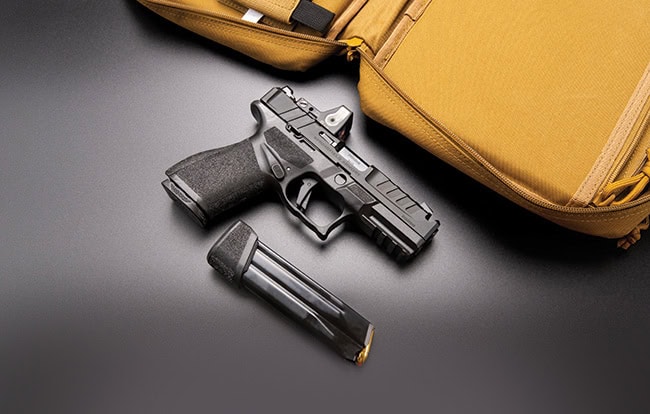
Image: Springfield Armory (Echelon 4.0C Comp 9mm)
After years of strong sales and record growth, it was predicted at the start of the year firearms sales would see a decline in 2025.
Overall, gun sales did fall at the beginning of the year, yet there is still a chance the dreaded “Trump Slump” won’t be as stark as previously feared. Retailers from across the country report the market for handguns remains robust this year, with several noteworthy trends emerging.
Micro-Compact 9mms Are Still King — Any Challengers?
Recent years have seen the micro-compact market surge, with these models now accounting for an 18% to 25% share and representing a quarter of all 9mm semi-automatic handguns sold. This isn’t likely to change in the coming months, although other calibers are gaining momentum. The subcompact 9mm pistol may be king, but it will increasingly face usurpers vying for its crown.
“9mm is the go-to caliber. Now I have seen 10mm start to increase due to its ability to work in suburban areas as well as wilderness environments,” noted Gerry Withag of Clik Clik Bang Firearms in Phoenix.
This sentiment was shared by Kai J. Bao of Appalachian Gun & Pawn in Jasper, Ga., who told Shooting Industry 10mm has been earning acclaim, especially from personal-defense experts and outdoor enthusiasts. He noted the caliber offers good ballistics, stopping power and size.
“9mm is regarded as the current gold standard for handgun carry; however, across many manufacturers, .380 is receiving a considerable revival due to its applicability within compact handguns, which can be designed and produced with greater concealability than their 9mm counterparts,” suggested Bao.
“There is a fairly large number of high-capacity micro compacts,” explained Kemlin Hart, owner of Hart Bros Guns & Ammo in Mason City, Iowa. “SIG P365s are losing favor due to media interaction, while GLOCKs do fairly well, which is kind of an all the time par to meet with.”
The growth of the subcompact market also means 9mm is no longer the only game in town.
In speaking with dealers, praise was also offered for the 5.7x28mm pistols due to their high-velocity, low-recoil performance. In contrast, offerings in 6.5mm, particularly 6.5 ACP and 6.5mm Grendel, have found favor for their “precision plinking.”
The Wheel Turns For Wheelguns
Even as we’re now a quarter of the way through the 21st century, the time-proven wheelguns that can trace their origin to the mid-19th century are still in favor with shooters across the country.
“Revolvers are always going to be ingrained in our heritage as Americans, whether you picture cowboys or detectives,” noted Bao. “However, manufacturers such as Smith & Wesson and Ruger continue to innovate in the wheelgun industry, and it keeps them relevant today.”
“Revolvers continue to attract enthusiasts of both CCW and competition,” added Edward [last name withheld by request], manager at GrabAGun in Coppell, Texas. He told Shooting Industry the leading brands in the wheelgun space include Smith & Wesson’s Model 69 and Model 66, Ruger’s GP100 and SP101 as well as Colt’s King Cobra and Python reissue.
“These models blend time-tested reliability with modern ergonomics and finishing options,” he continued.
Bao concurred and praised the Smith & Wesson Model 327 TRR8, pointing out how it is a modern and improved iteration of the more classic 627.
“Ruger, on the other hand, keeps some of their revolvers more classically inspired, such as the Vaquero line. It utilizes a classic Colt-style single-action frame but has been enhanced with modern internals such as a transfer bar safety, coiled hammer spring and a loading gate actuated cylinder release,” stated Bao. “These modifications allow the firearm to remain true to its heritage, but also relevant in the modern market.”
In the Midwest, Hart acknowledged wheelgun sales were on the slow side, but he told Shooting Industry Smith & Wesson is the dominant player in the centerfire world.
“Kimber has a great product; however, Kimber has hindered their sales in my mind,” suggested Hart. “After being a Kimber Master Dealer for over a decade with price protection, they decided to reward the distributors with better deals than their loyal dealers, which in turn makes my inventory overpriced at a wholesale level.”
The biggest drawback dealers found with wheelguns, based on consumer feedback, was the low round count, higher cost and limited caliber options.
Educating The Dealer, While Incentivizing Sales
There may have been a time, even in recent years, when firearms could sell themselves. This is not as much the case today, and even as consumers have endless options to conduct research online, manufacturers still need to step up their efforts in educating dealers.
Some are already taking the lead.
“GLOCK offers comprehensive in-dealer training kits, including videos and ‘shoot-and-learn’ guides, as well as point-of-sale displays,” lends Edward of GrabAGun. He added, “SIG SAUER provides certified training courses dealers can host, plus digital marketing assets, while Canik and CZ have robust online portals with sales aids, range-day templates and staff certification quizzes.”
In addition to those companies, the dealers told Shooting Industry Smith & Wesson and Springfield Armory are two more examples of companies in the industry that are doing an outstanding job providing materials for dealers, such as promotional products, customer rebates, law enforcement discounts, range packages or even rewards programs.
“The more common manufacturers, such as Smith & Wesson and Springfield Armory, are making more package deals, while other manufacturers, such as SIG SAUER and Taurus, are making many color options to encourage ladies into the industry,” noted Withag.
Hart also drew attention to Smith & Wesson’s employee rewards program, which he described as the “best” he has seen in the industry.
State Of Imports
As the country’s direction is to “Make America Great Again” and to buy American, the industry has seen some imported brands make inroads. These include SAR USA (Sarsilmaz), EAA (European American Armory) and Canik, all of which are gaining traction. Multiple factors contributed to the growth these companies have experienced.
GrabAGun’s Edward said this comes down to several key points, including excellent value for feature-rich pistols at aggressive price points; modern ergonomic designs that include polymer frames, optics-ready slides and adjustable backstraps; and strong import support, including rapid parts availability and local customer service.
“Canik is ‘hot, hot, hot’ — and has been for a while,” stated Hart. “SAR makes great pistols; however, market traction is not great at either of my locations. EAA/Girsan seems to perform okay, however, not stellar. Price and features for the money are why Canik, for instance, is doing as well as it is, especially their trigger.”
You get what you pay for, a point echoed by shooting enthusiasts across many online forums. Import brands can produce “clones” or close facsimiles of more well-known firearms and sell them at a much lower price than the genuine product, but this comes at the expense of authenticity.
Companies To Watch, And Hot Brands
Beyond the new import brands, other “up-and-coming” companies have the potential to garner more attention from customers in the coming months.
Hart told Shooting Industry a lot could depend on what makes it into the hands of influencers, where a good review can quickly put it in the spotlight. Both he and GrabAGun’s Edward suggested KelTec’s P-57, chambered in 5.7x28mm, was already generating buzz for its high capacity and low recoil.
“New boutique makers focusing on modular frames and drop-in ‘fire control units’ aim to combine customization with interchangeability,” added Edward.
Silence Is Golden
The final trend in handguns is in what may be the next must-have accessory: suppressors. For retailers, this could be something to shout about!
“In the near future, it is likely many new suppressor companies will rise in popularity as a result of President Trump’s ‘One Big Beautiful Bill Act,’ which will remove the $200 tax stamp,” forecasted Bao.
While he wouldn’t go so far as to suggest shooting suppressed handguns is going to be “the norm,” primarily due to the complexity of some suppressor setups on handguns, Bao expects it to become much more popular.
“We’ll be seeing it more often, especially on rifles due to their more natural point of leverage,” he said.
The question will be whether retailers can keep pace.
“With lead times, low demand has become very high, and this is a great market segment to be in,” explained Hart. “I don’t see a lot of them on my range here; however, they are very popular for rifles in my area.”