Boost Profits With Knives!
Knives Help Fill Out Your Bottom Line During Tough Times
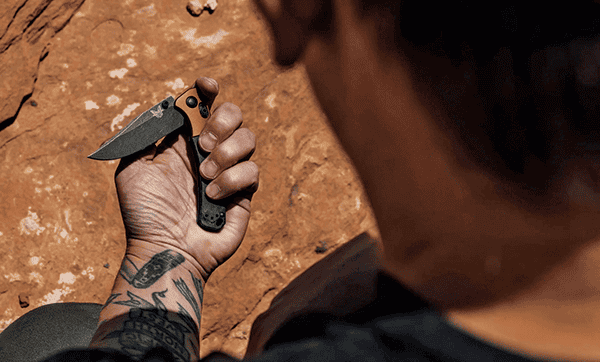
Image: Benchmade Knife Company
The good news about the financial state of our country is we have ended the stifling economy of the previous administration and are eliminating years of government waste. The bad news is the changes the Trump administration is implementing aren’t going to happen overnight. Even then, the sales of the firearms typically take a breather without the threats of a liberal government at the helm.
There is still a lot of “shaking out” to do and this is a good time for firearms dealers to diversify their stock with the added profits provided by cutlery. Shooting Industry spoke with representatives from two prominent cutlery manufacturers to get their views on what’s hot in the world of knives and what the impact the tariffs may have on the manufacturers, firearms dealers and consumers as these changes go forward.
The Current Cutlery Market
Alabama manufacturer Bear & Son Cutlery, founded in 1991, offers an array of fixed blade and folders produced domestically.
Bear & Son President Ken Griffey told SI, “The knife market is dynamic, with trends continuously evolving. Currently, we’re seeing strong demand for everyday carry (EDC) knives featuring automatic mechanisms such as out-the-front (OTF) designs and assisted-opening technology. In terms of aesthetics and durability, handle materials such as natural bone, Micarta, G10 and exotic hardwoods are gaining popularity.”
Kyle Stuart, marketing manager of cutlery manufacturing giant CRKT (Columbia River Knife & Tool) shared his observations on trends impacting the hunting segment.
“High-end blade steels such as MagnaCut are gaining a lot of interest among consumers. We’re also seeing an uptick in interest in pocket fixed blades as well as knives that use off-the-shelf utility blades,” he said. “Specifically for the hunting market, we’re seeing a move to more modern materials like Kydex versus leather sheaths and slightly smaller blades that are nimbler when field dressing.”
When it comes to EDC, Stuart added innovative designs stand out.
“There’s always demand for interesting designs and innovations beyond the basics. Some consumers tend to graduate into seeking more complex mechanisms and truly unique designs, which is where CRKT really shines,” he stated.
Benefits For FFL Holders
“While the market slowdown may impact sales of mid-to-higher tier firearms and accessories,” noted CRKT’s Stuart, “knives can still fill the need for a self-defense tool or simply ‘scratch the itch’ to get a new piece of gear at a more tolerable price point. And with so much competition in the knife industry, consumers will see many brands push harder in innovation, design and value.”
“The reality is simple: Everyone owns a knife — or could use another,” added Bear & Sons’ Griffey. “Just like firearms, knives are a core piece of gear for many customers. For firearms dealers, offering a selection of quality knives — especially American-made models — can be a smart and profitable move. Knives tend to have lower price points than firearms, but they can yield strong margins and consistent sales. Stocking a variety of styles, from tactical folders to hunting knives and EDC options, allows retailers to meet the diverse needs of their customer base and build basket value with every transaction.”
Tariffs & Their Effect
Expected tariffs imposed by the U.S. on foreign cutlery manufacturers and suppliers worldwide in the months to come could reshape the world of knives as we know it. The question is, to what extent?
CRKT built their company on cutting-edge designs by collaborating with notable custom knifemakers and having them produced offshore, particularly Taiwan. Over the years, they’ve added China — and others to a lesser degree — to the mix. CRKT is one of many manufacturers to have ventured down this trail.
Stuart addressed this issue, saying, “The impact of a prolonged trade war on those companies using imported steel or knives is still to be determined. By the time this issue publishes, it’s likely (hopefully) the trade war with China will have subsided, but I think we can still address this question.”
What were the immediate impacts of this trade war? Will it encourage U.S. knife makers to use domestic steel (or is there too much demand/cost-prohibitive with other industries and companies pursuing the same)? Or will things return to the status quo once the economic standoff has subsided?
Stuart continued, “The trade war forced many companies to quickly reassess their supply chains and scenario plans against an ever-changing trade policy. Many companies that have been in business for decades, in strong financial positions with an already diversified supply chain, will clearly be able to weather the immediate impacts better than younger companies still establishing a footing.”
According to Bear & Sons’ Griffey, “Tariffs on imported knives from China have led to significant price increases across many brands and that impact has been felt quickly. Bear & Son Cutlery is one of the few remaining U.S. manufacturers with the capacity to mass-produce quality knives domestically, and we’ve continued to invest in that capability over the long term.”
I also checked in with Mark’s Outdoors, a retailer in Vestavia Hills, Ala., that sells a bumper crop of knives per year. They informed me their three current bestselling brands are Benchmade, Spyderco and Kershaw.
All of Benchmade’s knives are made in the U.S. and the majority of Spyderco knives are made domestically. Kershaw is owned by KAI USA, a Japanese cutlery manufacturer that produces many of its knives at their factory in Tulatin, Ore. Retailers’ bestselling knives vary, but some stores, like Mark’s Outdoors, could adapt very easily.
Long-Term Outlook
“The long-term outlook for the knife market remains strong,” Griffey forecasted. “Demand for quality knives — whether for EDC, outdoor use or collection — is steady, and we expect to see growth among smaller U.S. companies.”
Griffey also anticipates continued expansion of offshore manufacturing in places like the Philippines and Taiwan.
“However, building consistent quality in those regions takes time and oversight,” he noted. “In the end, growth in our industry hinges on one key principle: offering a product customers are proud to carry.”
CRKT’s Stuart is cautiously optimistic.
“We believe long-term market growth will be moderate. To some degree, growth is dependent on a number of external factors such as trade policy, political party in office, loosening state knife laws and consumer trends in tactical and outdoor segments,” he reasoned.
Nimble responsiveness and a strong product line will win the day, according to Stuart.
“Growth in the knife market will come from a laser focus on a tight and excellent product assortment, being highly in-tune with the target consumer, maintaining strong relationships with market partners and relentlessly pursuing the next innovation,” he shared.
Hedging Your Bets
Where the tariffs end up is anybody’s guess, but going into fall, most dealers are fast preparing for the more lucrative hunting seasons to come. In a down political year, hedging your bets with affordable and profitable knives can keep your store’s bank account up during the slow periods to come.
Now would be a good time to establish relations with American cutlery manufacturers who produce their knives here in the U.S., and keep tabs on those who outsource their wares to Asian manufacturers, particularly China. Make sure your store has the edge!